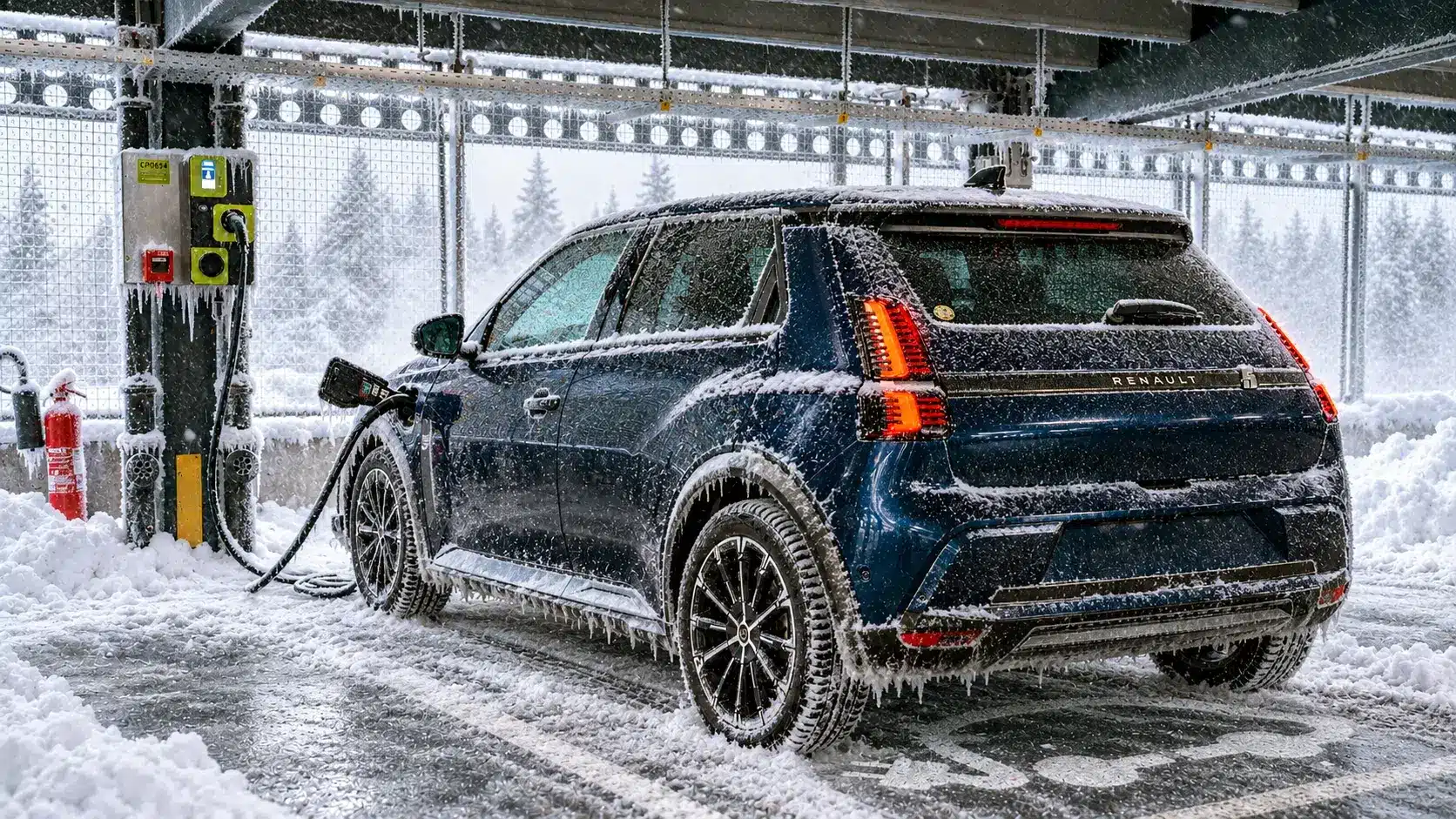
In a previous article, I explained how I charge my Renault 5 E-Tech without a charger at home. I touched on the prices of the different charging networks, but I didn’t go into what the car has actually cost me on average. You were waiting for the figures? Here they are.
After 3,806 km (2,365 miles) between mid-March and 20 October 2026, my Renault 5 E-Tech averages 20.1 kWh per 100 km (about 3.1 miles per kWh). I only charge on public chargers, at €0.44 per kWh on average, which works out at €8.67 per 100 km (about €0.14 a mile). In total, I paid €342 for charging in seven months.
A quick reminder: I’m Belgian, I live in Belgium and I commute to Luxembourg, so all my prices are in euros. If you’re in the UK, I’ve added a section on what the same driving would cost at British prices.
In short
- Renault 5 E-Tech running costs without a home charger: €8.67 per 100 km over 3,806 km (2,365 miles), charging only on public chargers (€0.44 per kWh on average).
- At 20.1 kWh/100 km (3.1 miles per kWh), it uses about a third more than its WLTP rating, because of short trips and cold weather.
- A Clio hybrid would have cost about a third more on the same trips (€110 more in seven months), and my old Peugeot 208 even more (€179).
- At UK public charging prices, the gap with the hybrid disappears: in Britain, the real savings come from charging at home.
But before going into the figures, I need to explain how I collected them.
How to work out an electric car’s real consumption
I used three main pieces of data:
- the distance driven;
- the battery level (state of charge, or SoC) at the start and end of each charge;
- the kWh billed.
For the kWh billed and their price, it’s simple but time-consuming. I collect every invoice from the charging providers (Electra, Fastned, Allego, Mobilize…) and pull out the dates, the kWh billed and the price including VAT.
For the distance, I have several sources. If I trusted my own discipline, I’d have kept a little notebook and written down the mileage at every charge. Luckily for me, modern cars are connected and keep quite a lot of data, including (but not only) the odometer reading.
Like my other connected devices, the Renault 5 is linked to my Home Assistant hub, so its data is stored over the long term. With the time of each charge, I can find the mileage.
But the source I used most is the excellent Kelec app. It does everything the official My Renault app does… only better. In particular, it can export your charging sessions as a raw data file. Among other things, the file contains the timestamps, the battery level at the start and end of each charge and, therefore, the amount of energy.
A tip while I’m at it: the car only keeps six months of charging history. If you don’t export your data at least every six months, you lose some of it.
With all this, I was able to rebuild a logbook of my consumption.
The calculation itself is simple. Between two charges, I look at how much the battery level has dropped. If I unplug at 80% and plug back in at 40%, the car has used 40% of its 52 kWh, which is 20.8 kWh. I then divide by the distance driven between those two charges, and I get a figure per 100 km. It’s the good old brim-to-brim method from petrol cars, adapted to electric.
To check that this method holds up, I compared it with the invoices, and both give almost the same result.
For the cost, every kWh used is valued at the price I actually paid at the charger. The €342 is everything I paid for charging. Part of that energy, from my last charge on 20 October, was still in the battery at the end of the period, hence the small difference with the €8.67 per 100 km.
So, what’s the damage?
To be honest, I hesitated a lot before writing this article. Not because I’m unhappy with my purchase: I’d make exactly the same choice again. But I wasn’t sure how to present the figures.
Everyone uses their car in their own way, so consumption varies more or less depending on that use. In my case, I use more than average.
The reason is simple, but I need to give you a bit of context. As I explained in my first article, part of my driving is very short trips. That may seem trivial, but for any car, petrol or electric, it isn’t the best way to use it.
Petrol or electric, a car needs a few kilometres before its consumption settles down. A petrol engine has to warm up a little before it runs at its best. With older generations of cars, we were even told to let the engine warm up before setting off.
An electric car has the same constraint. It’s not the motor that needs to warm up, but the battery. So for the first two or three kilometres, consumption is higher.
My previous car, a Peugeot 208, averaged a little over 7 litres per 100 km over a year (under 40 mpg). That’s obviously not what a Peugeot 208 does in ideal conditions. You’d expect something closer to 4.5 litres per 100 km (about 63 mpg), the official combined figure for this model (a 2014 1.2 PureTech 82 hp), measured on the old NEDC test. Keep that in mind when I explain my consumption and what I paid per 100 km.
Titine doesn’t like the cold or short trips
It’s no secret: an electric car doesn’t use the same amount of energy in summer and in winter. Titine (that’s what I call my R5) is no exception, and the figures clearly show the warm periods (above 12°C) and the cold ones.
Here are the figures over seven months, showing how much I drove and how much the car used. The only long trip was in August, which brought the cost per 100 km down because I charged a few times in France (once for free, thanks to a Fastned promotion).
| Month | km | Miles | kWh/100 km | € per 100 km |
|---|---|---|---|---|
| March (from the 14th) | 237 | 147 | 24.6 | 8.44 |
| April | 595 | 370 | 23.1 | 11.10 |
| May | 453 | 281 | 19.1 | 9.13 |
| June | 451 | 280 | 19.0 | 9.25 |
| July | 568 | 353 | 17.8 | 7.31 |
| August | 1,018 | 633 | 18.3 | 6.47 |
| September | 194 | 121 | 19.8 | 10.06 |
| October (to the 20th) | 290 | 180 | 24.2 | 11.78 |
| Total | 3,806 | 2,365 | 20.1 | 8.67 |
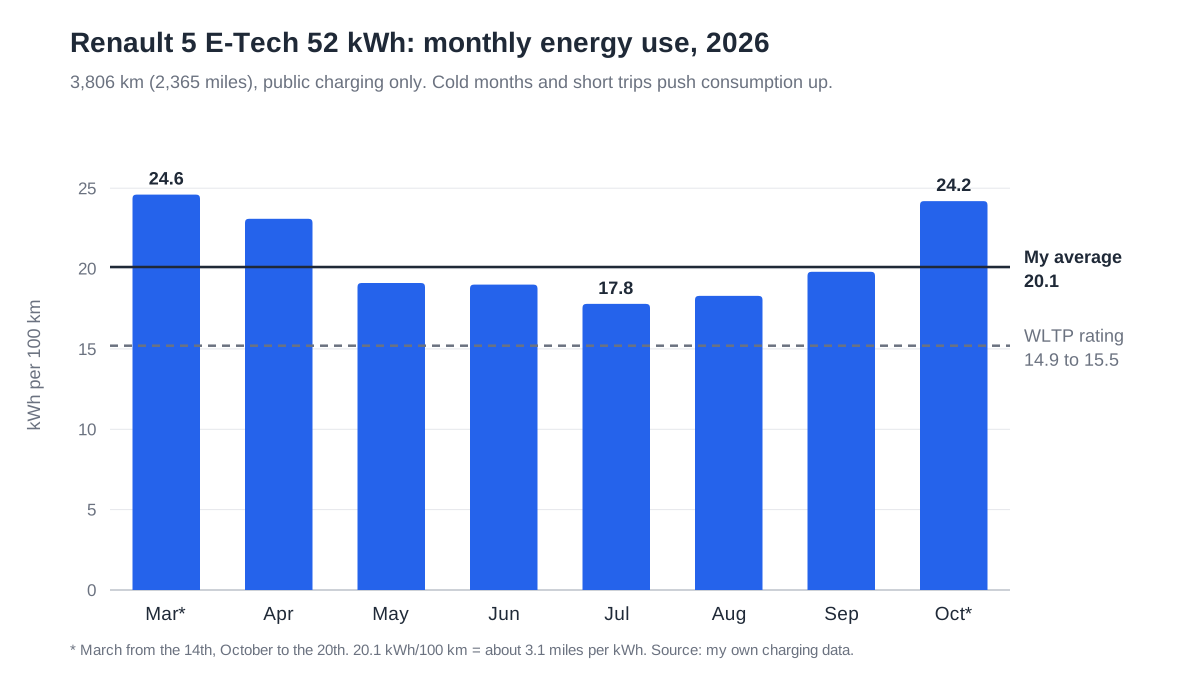
For reference, the Renault 5 52 kWh is rated at 14.9 to 15.5 kWh/100 km on the WLTP cycle, or about 4 miles per kWh. At 20.1 kWh, I use about a third more. That’s a lot, but my 208 did worse with the same driving: 7.2 litres instead of the official 4.5, or 60% more (even if that official figure came from the old NEDC test, which was more optimistic than WLTP).
How much would I have spent with a modern hybrid?
Comparing only with my old 208 wouldn’t have told you much. So I took the closest car to the R5 with a hybrid engine: the new, sixth-generation Renault Clio E-Tech full hybrid 160. Over the same period and on the same trips, it would have used about 6.2 l/100 km (45.6 mpg), which means 237 litres and roughly €440 of petrol (€11.56 per 100 km, at an average pump price of €1.86 a litre in Belgium). My R5 cost me €330 for the electricity it actually used over those kilometres: 25% less, a saving of about €110 in seven months. Compared with my Peugeot 208 and its 7.2 l/100 km, the gap rises to €179.
The amount doesn’t quite match the one at the start of the article? Well spotted. The €342 at the start is all the kWh the charging operators billed me. The €330 here is only the electricity the car actually used to drive those 3,806 km. The difference, about a dozen euros, is the energy from my last charge, still in the battery on 20 October.
That 6.2 l/100 km isn’t the official WLTP figure (3.9 l/100 km, or 72 mpg), and that’s not a mistake. It’s a month-by-month estimate, based on real-world tests and adjusted to my trips. For short trips in cold weather, I used 7 l/100 km (40 mpg): L’Argus (in French) warns that it can climb as high as 9 l/100 km on round trips to a station 3 km away, and Les Voitures (in French) measured 6.2 l/100 km in town in winter, on short trips. On a cold start, the hybrid’s petrol engine runs to heat the cabin and the battery, and the trip is over before the hybrid system has had a chance to help. For my commutes to Luxembourg, I used 5.5 l/100 km (51 mpg), between the 4.3 litres L’Argus measured on ordinary roads and the 6.3 litres on the motorway at 130 km/h (81 mph). For the August trip, I used those 6.3 litres: on the motorway, a hybrid brings almost nothing.
What would it cost in the UK?
My figures are Belgian, so here’s a quick conversion for British readers. According to the Zapmap Price Index, the average pay-as-you-go price on standard public chargers (the slower chargers I use) was 54p per kWh in September 2026. At my 20.1 kWh/100 km, that’s about £10.85 per 100 km, or 17.5p a mile.
For the hybrid, with unleaded at around £1.74 a litre in October 2026 (Fuel Finder UK), the same 6.2 l/100 km comes to about £10.80 per 100 km. In other words, with my driving and British public charging prices, the Renault 5 and the Clio hybrid would cost almost exactly the same to run.
Where an electric car pulls far ahead in the UK is home charging, especially on an off-peak EV tariff. I don’t have that option, but if you do, the comparison isn’t even close. If you don’t, look for cheaper networks and memberships (Octopus Electroverse, which I use in Luxembourg, is a British service), and remember that cost may not be the main reason to switch anyway.
Conclusion
So, is owning an electric car without a home charger a bad idea? No. For a start, in my case it costs almost a quarter less per 100 km. And an EV isn’t just about the cost per kilometre, even if fuel is unlikely to get cheap again. Taxes and “polluter pays” charges will add another layer to today’s prices. My view is that €1.80 to €2 a litre will become the norm in the years to come.
And that’s without the real reasons to go electric: smooth driving, power that’s there when you need it without any jerkiness, a car that defrosts itself, and so on. You just have to unlearn a few petrol-car habits at first, as I explain in my 5 beginner mistakes with the Renault 5.
In the end, it isn’t cost that won EV drivers over. It may have weighed in at first, but test-driving the different cars gives plenty of other reasons to switch. Anyone who has nothing but objections on the subject has probably never driven an electric car.
What about you: are you already driving electric, or still on the fence?




Leave a Reply