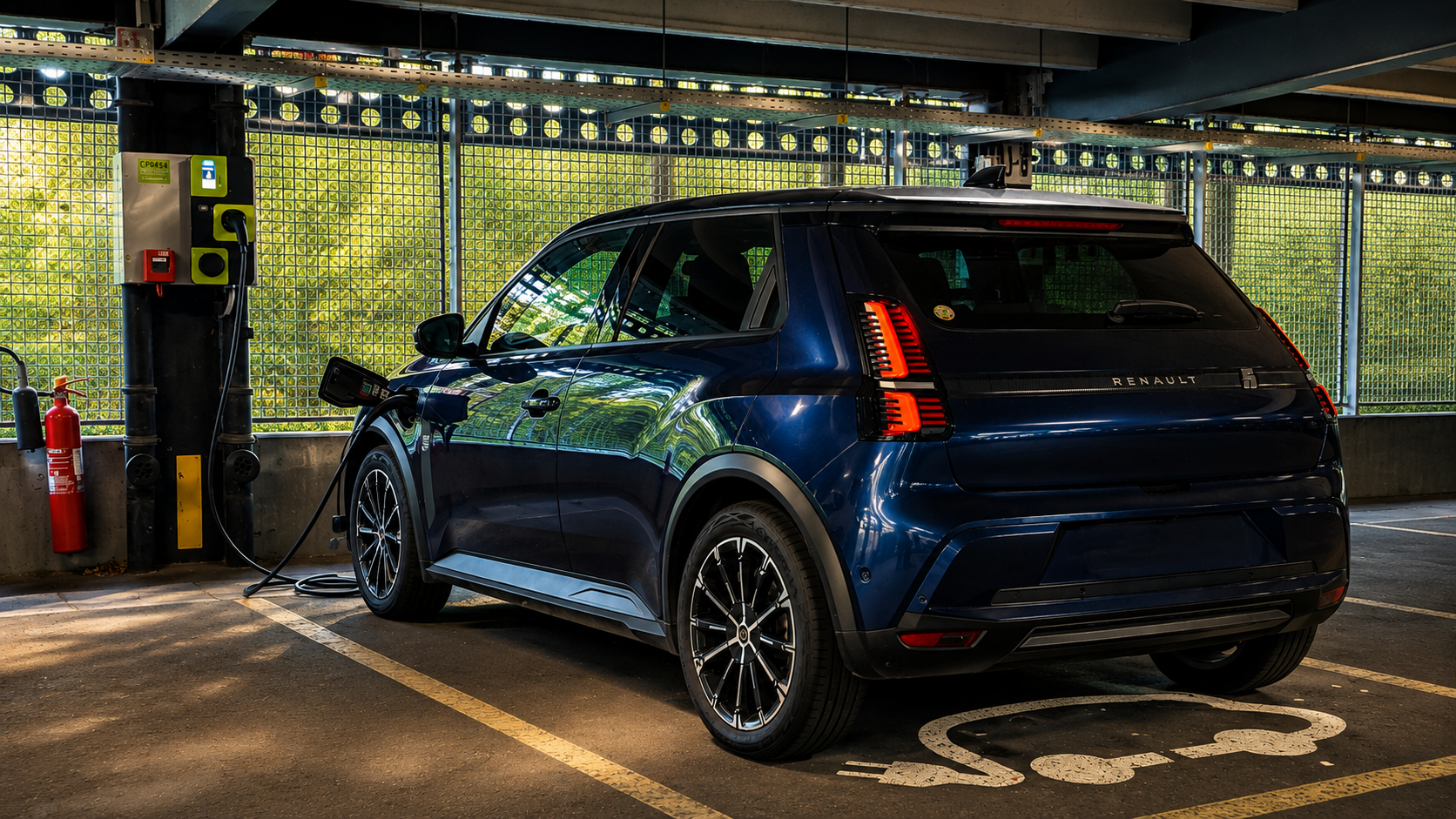
Since this year, I’ve been the proud owner of a Renault 5 E-Tech. Yet I live in a flat and have no way of charging at home. So why buy one, why go electric, what has changed in my habits, and is it really possible?
If you’re also hesitating about switching to electric, or feel pushed towards it whether you like it or not, this article is for you.
You’ll see that what matters isn’t where you can charge, but where your car stays parked for a good part of the day.
A bit of context: I’m Belgian, I live in Belgium and I commute to Luxembourg, like many cross-border workers. Most days I take the train; some days, the car. That’s why this article travels between two countries and two charging networks.
In short
- Yes, you can live with a Renault 5 E-Tech without a home charger: after 2,500 km (about 1,550 miles), I only charge on public AC chargers.
- The key: charge where the car is already parked for several hours (station car park, park-and-ride in Luxembourg).
- The price per kWh varies a lot depending on the card, from €0.588 (Mobilize) to €0.40 (Octopus Electroverse on Chargy).
- The real constraint isn’t range, it’s planning, especially for the weekend.
From petrol to electric: a carefully considered choice
At the beginning of March, I swapped my old car for a Renault 5. It’s my first electric car after several petrol ones, and it was a deliberate choice. I’d been thinking about going electric for years. To be precise, my interest dates back to the arrival of the first Renault Zoe and Nissan Leaf, in the early 2010s.
They were small electric cars that looked like real cars, not golf buggies. They drove well and had everything you needed within a certain range. The only stumbling blocks were the price, reliability and battery lifespan. So I stuck with petrol.
About fifteen years later, I looked again. The Zoe is no longer on sale, replaced by the Renault 5, which plays the nostalgia card for the original model. Tesla makes some of the best-selling cars on the planet. And looking ahead to 2035, Europe is pushing the new car market very hard towards low- and zero-emission vehicles anyway.
Petrol car prices were going up, and more affordable electric cars were arriving among small city cars. It was time.
Living with an electric car without a home charger
I wasn’t, and still am not, what car dealers would call an “EV-ready” customer. I live in a flat with outdoor parking. It wasn’t wired or pre-wired for a charger, even though the neighbourhood is brand new. Hats off to the developer, clearly very much in tune with the times. Goodbye to the savings of charging on household electricity or on my solar panels.
That leaves public chargers. There are two kinds of charging:
- AC: slow, but perfectly suited to a car that stays parked for several hours.
- DC: fast, particularly useful when you want to get back on the road quickly.
I’d anticipated all this before buying. Before you own an electric car, you think there aren’t enough chargers. Once you’ve made the switch, you see them everywhere.
I’d already found two AC charging sites that would cover 90% of my needs. The first, run by Allego, is in the station car park. As a daily train commuter to Luxembourg, I leave the car there all day. That looked like a good plan.
For weekends, a charging site was due to be installed in the new neighbourhood where I live. Just a few dozen metres to walk to charge Titine (that’s what I call her), and a bit of exercise never hurt anyone.
Finally, I sometimes drive to Luxembourg on days without trains (strikes, engineering works, a farmer who has driven through the barriers of a level crossing…). For those days, I’d found the Chargy chargers at the Bouillon park-and-ride, on the edge of Luxembourg City. More than 60 public chargers are installed on the ground floor of the covered car park.
And when I signed the order form (Titine was in stock somewhere in the port of Zeebrugge), the salesman had already given me the paperwork for the Mobilize Charge Pass card, Renault’s own charging card. That meant I could activate it before I even had the car.
Charging in real life, five months later
But all that was the initial plan. Five months and 2,500 km (about 1,550 miles) after delivery at the beginning of March, let’s see how theory turned into reality.
Before going into detail, I need to explain how public chargers work. Usually, an operator gets a concession from a shop, a town or a transport company to install its chargers in public or semi-public car parks.
To pay, you have three options:
- The charging operator’s own card or app.
- The card or app of a mobility service provider.
- A bank card (but still too rarely on AC chargers, and almost never at reasonable prices).
Mobility service providers are companies that act as middlemen between the charging networks and drivers, who don’t necessarily have an account with every network. They often add a margin on top of the operator’s price. Sometimes they have negotiated prices.
At first, you’ll collect charging cards and operator apps. Then you’ll sort through them by trial and error, comparing prices and your parking habits. Here’s how I went about it, and how I sorted the different offers I’ve tried or looked into.
The station car park, where my R5 spends its days
My first charge in the commuter car park was with Renault’s Charge Pass. Being cautious, I didn’t do it for real on a working day, but on a quiet Saturday, with no audience and no pressure. As a brand new EV driver, I needed more running in than the car itself.
Everything went fine, but after seeing the bill and looking up this charger, I realised that, as with all chargers, not everyone pays the same price. Mobilize’s price, €0.588 per kWh, isn’t the cheapest. By downloading the Allego app, I got the operator’s own price of €0.53 per kWh. And that’s not all. Since I have a season ticket with SNCB, the Belgian railways, I’m entitled to the commuter rate of €0.48 per kWh, €0.10 less than with Mobilize. It took Allego four months to reply and apply the commuter rate retroactively to my charges.
Even without a charger at home, being able to charge where the car spends four to five days a week gives me a lot of flexibility and doesn’t change my schedule at all. I spend one minute plugging it in in the morning and one minute unplugging it in the evening. The chargers are close to the platform entrances, which draws a few looks: a Renault 5 in what look like VIP spaces.
That said, it doesn’t stop me from commuting to Luxembourg in the Renault 5 when I have to.
Chargy, Luxembourg’s well-kept charging secret
I’m far from a fan of commuting by car, but when you have to, you have to. The park-and-ride is free, covered and equipped with plenty of chargers from Chargy, Luxembourg’s national charging network. It was designed precisely so that people without a home charger can charge their electric car. It’s a national, standardised network, with no surprises.
Unlike Allego or Energyvision, Chargy has no card or app of its own: you can only use its chargers through third-party cards or apps. To get Chargy’s recommended price without a card provider’s commission, you need a card from Enovos, Luxembourg’s historic electricity supplier, which costs €12. The Mobilize Charge Pass price is €0.485 per kWh, while the Chargy price is €0.46 per kWh. I’d worked out that I’d need about fifteen charges to pay off the €12 card.
But that was before I discovered Octopus Electroverse, from the British energy supplier Octopus Energy. Their card is free, and either they take no margin on charging or they have negotiated prices.
In the interest of transparency: the Octopus Electroverse link is a referral link. If you sign up with it, I get some charging credit on my Electroverse account, just like any Electroverse member who refers a friend. No money, just a few kWh.
I don’t know what magic they used to get €0.40 per kWh on Chargy, but it suits me just fine. The purple card goes everywhere with me in Luxembourg.
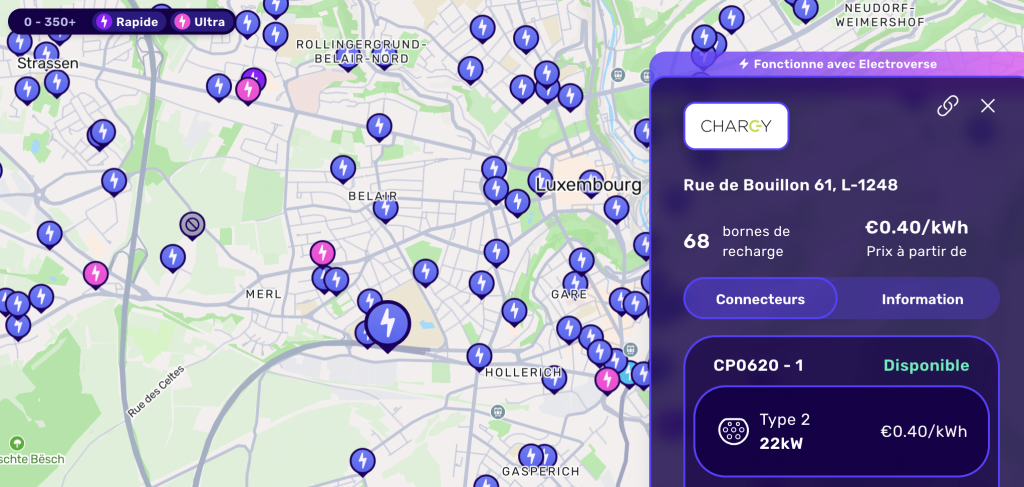
As for the car park itself, with its spaces on the ground floor, charging days are child’s play. One minute to plug Titine in, and plenty of time to jump on a bus to the city centre. In the evening, one minute to unplug and drive off.
In the morning, the taxis that regularly use these chargers overnight are just starting to free them up. Everyone seems to win: they take advantage of off-peak hours to charge at night, and commuters gradually take over during the day.
Finally, the Renault 5’s range isn’t a problem, even for these commutes to Luxembourg. It can do three round trips between charges without pushing its limits. I could clearly commute by R5 for long periods if I needed to.
The one exception: the developer only made promises
If you’ve been following closely, you’ll have noticed there’s still a gap in the plan: charging in my street. At the time of writing, the chargers aren’t there. The spaces are paved, the cables stick out of the ground, the 400-volt cabinet is in place, but the chargers are still nowhere to be seen.
It’s turning into a bad comedy sketch, and it would deserve an article of its own.
The downside is not being able to use a charger where the car spends most of its parked time: near my home. In practice, I have to plan for the weekend and charge on Friday, or else top up somewhere. It hasn’t come to that yet, but I can’t wait for this limitation to disappear.
Needless to say, I have no idea what these chargers will cost per kWh.
Summary: how much does a kWh cost with each card?
Here are the prices I noted in August 2026, from most to least expensive. They can change, so check them before choosing your card.
Update (October 2026): Chargy prices went up on 1 October. Octopus Electroverse is now €0.47 per kWh and Enovos €0.528 per kWh, so Electroverse is still the cheapest card on Chargy.
| Card | Price per kWh | Full charge, 40 kWh | Full charge, 52 kWh |
|---|---|---|---|
| Allego · Mobilize | €0.588 | €23.52 | €30.58 |
| Allego · app | €0.53 | €21.20 | €27.56 |
| Allego · SNCB commuter rate | €0.48 | €19.20 | €24.96 |
| Chargy · Mobilize | €0.485 | €19.40 | €25.22 |
| Chargy · Enovos | €0.46 | €18.40 | €23.92 |
| Chargy · Electroverse | €0.40 | €16.00 | €20.80 |
About the cards: the Mobilize Charge Pass is offered to new owners of an electric Renault, the Allego app and Octopus Electroverse are free, and the Enovos card costs €12. “App” means the Allego app, and “SNCB commuter rate” is Allego’s discounted price for SNCB season ticket holders.
On Chargy chargers, Octopus Electroverse worked out about 17.5% cheaper than the Mobilize Charge Pass at August prices (€0.40 versus €0.485), saving more than €4 on a full 52 kWh charge. At Allego, the real lever is the commuter rate, as long as you claim it.
Conclusion
So, is life without a home charger possible, 2,500 km later? In my situation, clearly yes. Not everyone’s situation is the same. Your life isn’t mine, and this article isn’t meant as a blueprint for organising your life with an electric car. But it may give you some ideas and, I hope, the urge to look at your own situation with an open mind.
Looking back, I’ve realised that the real question isn’t so much whether you have a charger at home, but whether you can charge where your car is already parked for several hours.
What many people see as a constraint has become a routine of less than two minutes a day, on the days I need to charge. For one thing, my Renault 5 doesn’t need charging every day. For another, wherever I charge it, it spends several hours there anyway.
The only real cloud on the horizon is that car park near my home, wired and paved, still waiting for its chargers. The day they arrive will probably be the subject of my next article, where I’ll finally tell you the saga of these chargers. Hopefully without having to wait fifteen years, as I did for my R5.




Leave a Reply