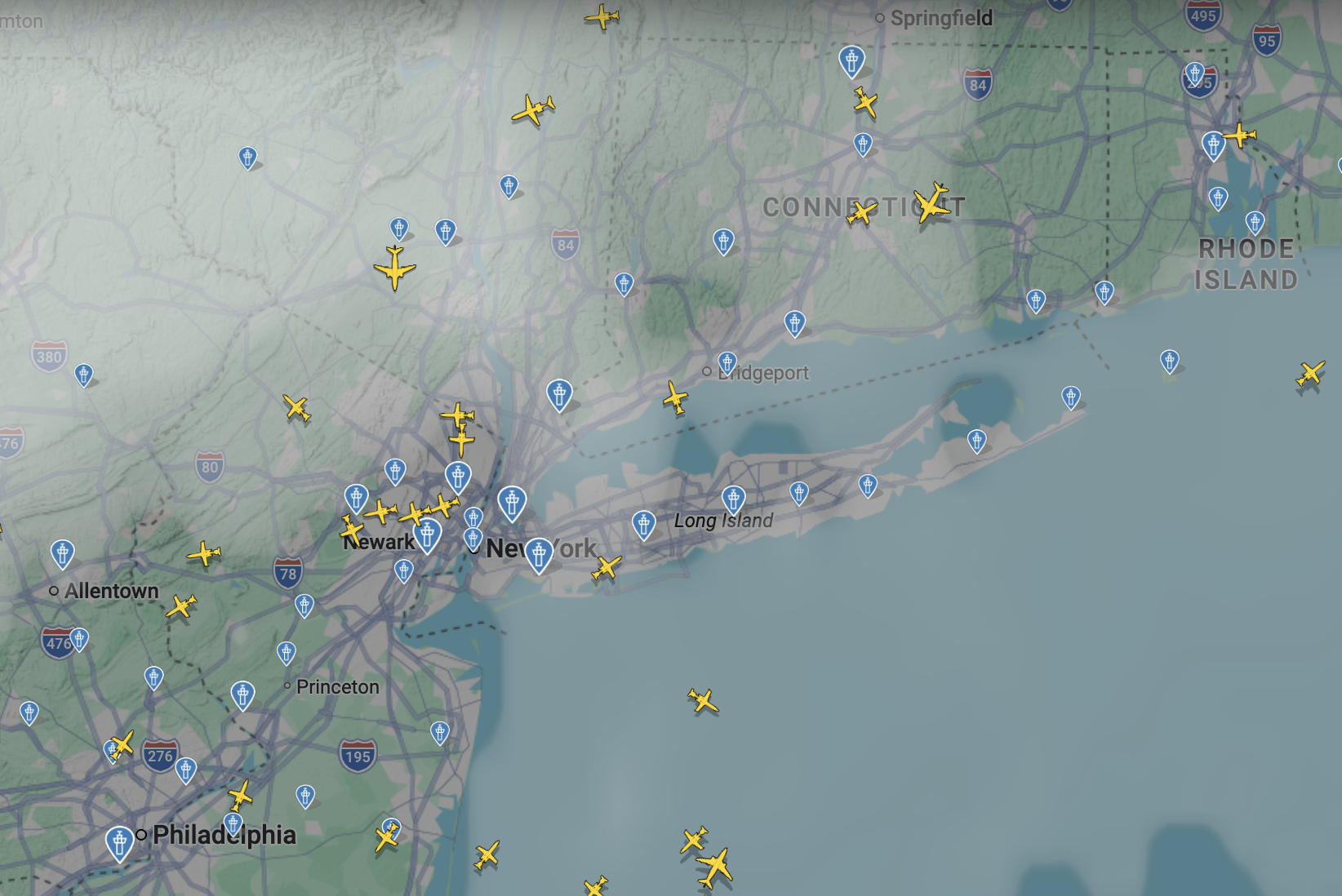
You may have heard of Flightradar24 without really knowing what it is. Or perhaps you discovered it during an event that suddenly made global air traffic very real: a war breaking out, an airspace closing, planes vanishing from the map.
Flightradar24 shows you, in real time, where planes are flying around the world. And in recent years, there’s been no shortage of reasons to look. The closure of Ukrainian airspace since Russia’s invasion in 2022 has redrawn the routes between Europe and Asia. Restrictions around Iran and the Persian Gulf have forced hundreds of flights into long detours over the Arabian Sea or Central Asia, and periods of tension in the Strait of Hormuz have done the rest. As a result, the tool has become a must for anyone who follows the news or is waiting for a loved one at the airport.
But Flightradar24 is also, more simply, a way to reassure someone who worries about you while you’re in the air. Here’s how to use it and, above all, how to make sense of what you see when a plane isn’t where you expected it to be.
First published in 2014 on my French blog, fully updated in 2026.
In short
- Flightradar24 shows the position of planes flying around the world on a live map.
- You can track a specific flight, check its arrival time and see the route it has flown.
- Its data comes from the planes themselves, picked up by a network of receivers: very complete, but not infallible.
- The free version is enough for most people; paid plans mainly add flight history and extra details.
How do Flightradar24 and ADS-B work?
To use an app well, you need to understand what it does and how. Flightradar24 isn’t a radar in the traditional sense. In other words, it doesn’t actively look for planes: it listens to what they broadcast.
To understand the difference, you need to know that there are two kinds of radar.
Primary radar is the one most people know. Developed during the Second World War, it sends out a signal that bounces off the aircraft and returns to the antenna. That way, it can work out the position of a plane even if the plane doesn’t cooperate.
Secondary radar, on the other hand, interrogates the aircraft. The plane’s transponder replies with a whole series of information: its identifier, altitude, speed… Air traffic control then combines these replies with primary radar data.
ADS-B (Automatic Dependent Surveillance–Broadcast) goes even further: the plane no longer even waits to be asked. It continuously broadcasts its own GPS position, altitude, speed and flight number. Any receiver within range can pick up these messages.
That’s the principle Flightradar24 is built on. The service collects these signals through a vast network of ground receivers, many of them installed by enthusiasts. It adds multilateration (MLAT), which works out the position of a plane without ADS-B by comparing when its signal reaches several receivers, satellite receivers for oceans and, in North America, data supplied by aviation authorities.
So most positions come from the planes themselves, not from air traffic control. That’s why Flightradar24 isn’t always 100% reliable: a plane’s transponder can malfunction, or the aircraft can fly through an area the network doesn’t cover.
How to track a flight in real time (or check a delay)
This is the most common use: reassuring a loved one, or knowing when to leave to pick someone up at the airport. All you need is the flight number to see where the plane is in real time.
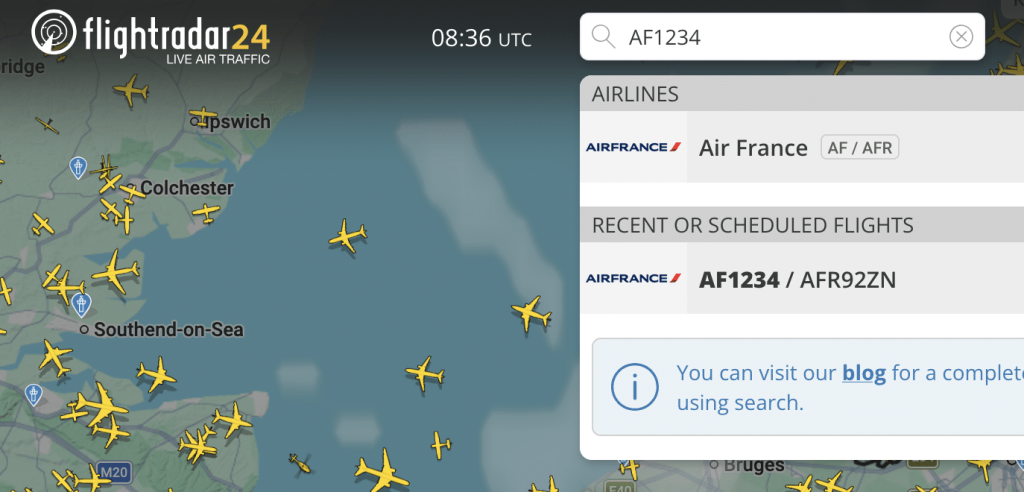
The interface has changed since the site’s early days, but the principle remains the same. At the top of the screen, there’s a search box. You can search for several kinds of things (airport, airline, aircraft registration), but what we want here is a specific flight. Just type its number (for example BA117 or LH456).
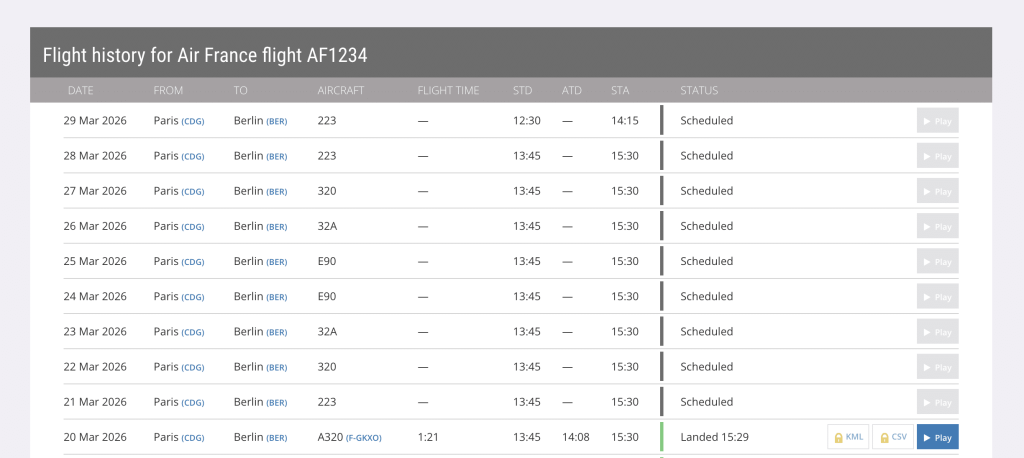
A result appears under the search box. Select it, and the site shows the list of recent flights with that number. For a daily flight, there’s one line per day. If the plane is already in the air, the matching line is highlighted, and an arrow on the right takes you to it on the map.
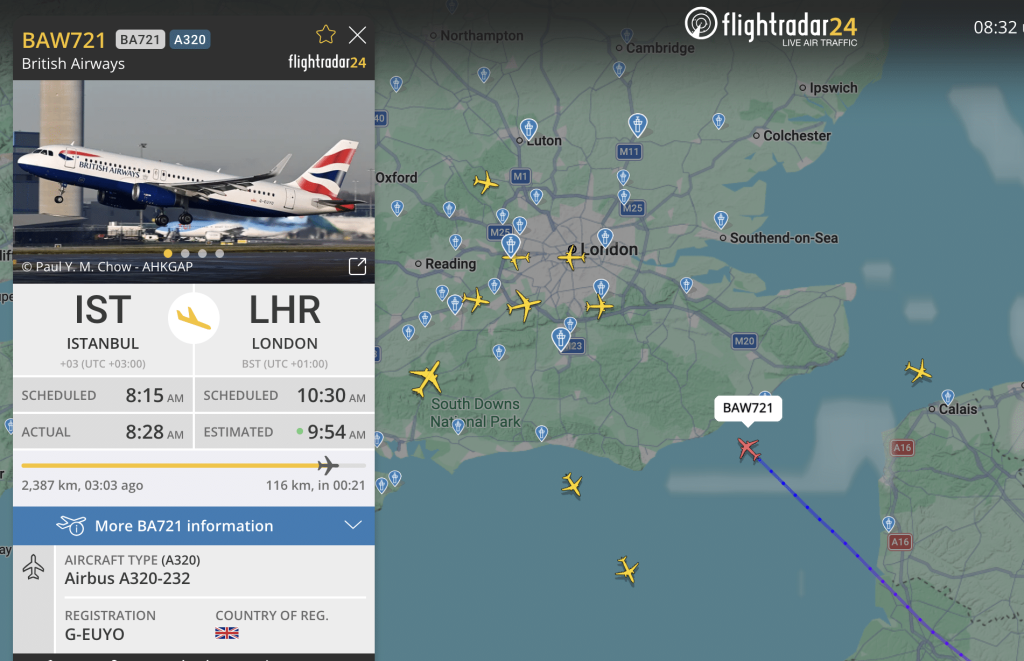
You then see the plane’s position and the route it has already flown. The remaining flight time and estimated arrival time are shown too. The aircraft is identified and, for most airlines, illustrated with a photo.
You can also use the search box to check the arrivals and departures board of an airport, whether it’s Heathrow, Manchester or the airport where you’re picking someone up.
See a plane’s route on the map and replay a past flight
When you select a plane, Flightradar24 draws the route it has already flown since take-off on the map, and the line to its destination. It’s the simplest way to see the actual route of a flight and, for example, the detour forced by a closed airspace.
The site also lets you replay a flight that has already landed, with the playback feature. Search for the flight number or the aircraft registration, pick the flight you want from the list, then start the playback: the plane retraces its route on the map, speeded up if you like. With the free version, the history goes back 7 days.
And if you’d rather keep a record of your own trips, Great Circle Mapper lets you create a map of all the flights you’ve taken.
Why do some planes disappear from Flightradar24?
There are several reasons why a flight might not appear on the map:
- The flight hasn’t left yet, or it has already landed.
- The plane is flying over an area with poor coverage, such as some ocean regions or sparsely populated areas.
- The transponder is broadcasting in a mode that Flightradar24’s ADS-B network doesn’t pick up, or it’s faulty.
- The airspace is closed or the flight has been diverted because of a conflict, a crisis or a decision by the authorities. Planes then take other routes, sometimes outside the usual coverage.
- It’s a private flight and its owner has asked for the registration to be hidden.
- It’s a military or government flight: these aircraft generally don’t broadcast their position publicly.
That said, Flightradar24 has greatly improved its global coverage since 2014, thanks to more and more ground receivers and the addition of satellite data for ocean areas.
Is Flightradar24 free?
Yes. The free version, on the website and in the app, is more than enough to track a flight live, check an airport’s arrivals and departures, or replay flights from the last 7 days.
Flightradar24 also offers paid plans, Silver and Gold, for enthusiasts. They mainly add flight history (90 days with Silver, 365 days with Gold), extra aircraft details, filters and alerts, plus weather and aviation layers with Gold. A Business plan, with three years of history, is aimed at professionals. Prices vary by country, and each paid plan comes with a 7-day free trial.
The Flightradar24 mobile app
The app, available on iPhone and Android, has the same features as the website: search by flight number, live map, replay of past flights. It adds a fun extra: point your phone at a plane in the sky, and the app tells you which flight it is, where it’s coming from and where it’s going.
And if you’re the one on board, remember airplane mode… which, by the way, is just as useful at the office.
Alternatives to Flightradar24
Flightradar24 isn’t the only flight tracking service. FlightAware, born in the United States, long focused on North America thanks to FAA data. It now has its own network of ADS-B receivers and worldwide coverage, and it’s particularly thorough on schedules and delays.
Other alternatives include Plane Finder, which works very much like Flightradar24, and ADS-B Exchange, popular with enthusiasts because its data is less filtered.
Frequently asked questions about Flightradar24
How can I find out where a plane is right now?
Type the flight number into the Flightradar24 search bar, select today’s flight, and the plane appears on the map with its position, route and estimated arrival time.
Is Flightradar24 reliable?
Yes for the vast majority of commercial flights, but not 100%. The data comes from the planes themselves and from ground or satellite receivers: an area with poor coverage or a faulty transponder can make a plane disappear temporarily.
Can I see the route of a past flight?
Yes, with the playback feature. The free version gives you access to the last 7 days; the Silver and Gold plans extend the history to 90 and 365 days.
Why isn’t my flight showing on Flightradar24?
The flight may not have left yet or may already have landed, it may be flying over an area with poor coverage, it may have been diverted, or it may be a hidden private or military flight.
People will tell me this ending is a bit of a cliché again, but… have a good flight!



Leave a Reply