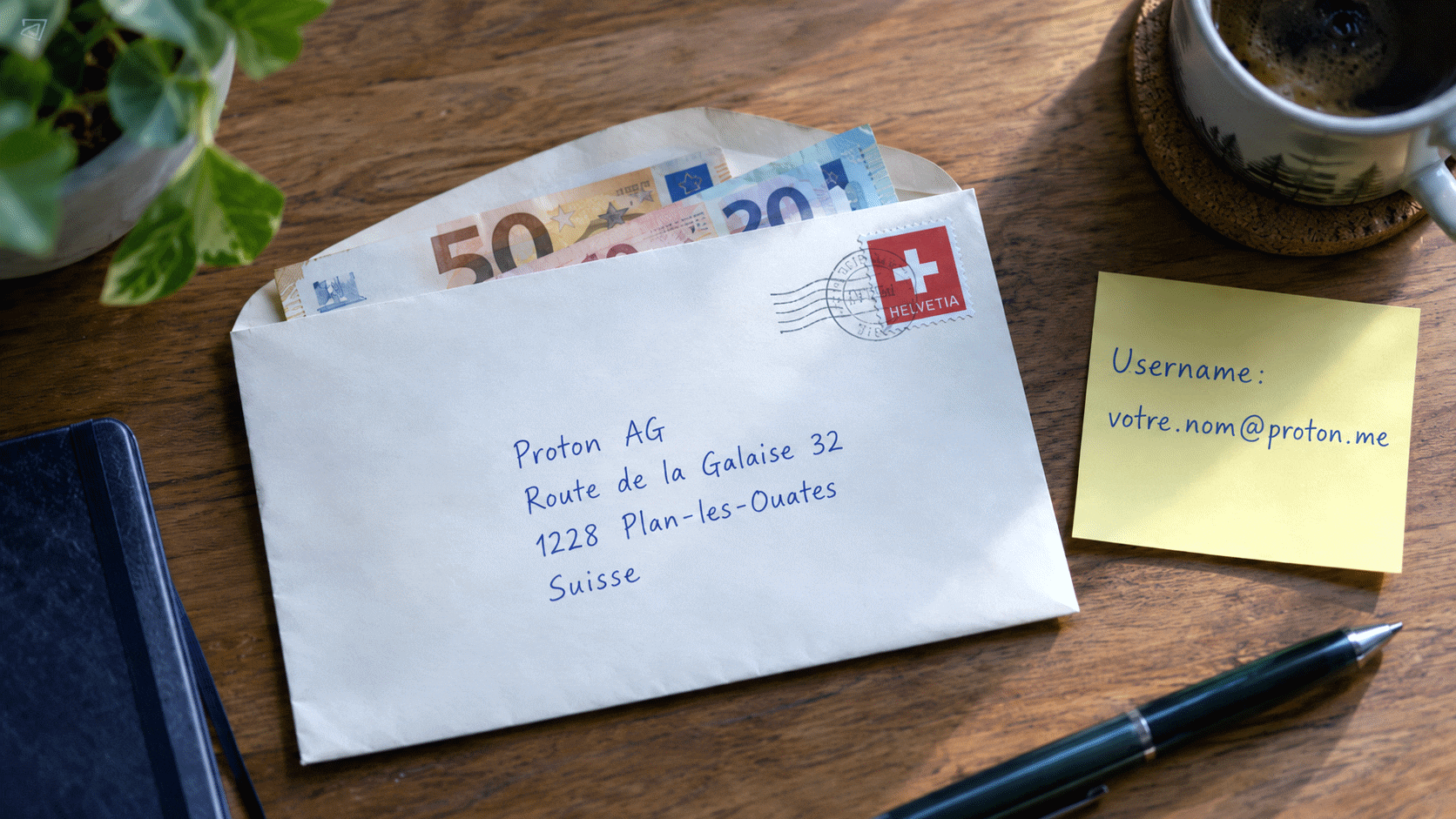
You protect your connections when you use Proton and you are careful not to leave a trail. But have you thought about how you pay for it? Proton lets you pay with cash, sent by post. An American activist would have loved to know that. The question is how far you are willing to go to keep your Proton account separate from your identity.
When Proton is legally compelled to hand over data about you, it does not have much to give. Yet that little something may be exactly what gives you away.
In short
- Paying Proton by card or in Bitcoin leaves a trail that can lead back to you. Cash sent by post is the only option that requires no identity at all.
- But slipping banknotes into a letter is banned in Belgium (except with declared value), Luxembourg and France, and many other countries restrict it too.
- Swiss Post does not exclude cash from domestic mail: posting the envelope from inside Switzerland is the most realistic option.
- Cash alone is not enough: use a VPN and skip the recovery email.
IP address and recovery email: two traces that are easy to erase
If you are thinking of IP addresses or your account’s recovery email, you are not wrong. Proton can be forced to log the IP addresses used to access a specific account. And the recovery email is necessarily readable by Proton, otherwise the recovery process could not work.
The fix is fairly simple, and Proton recommends it. To hide your IP address, use a VPN that does not log your IP addresses. Proton happens to run one. Trusting the same company with both links in the chain may feel counter-intuitive, but Proton says that under Swiss law a VPN service cannot be forced to log its users’ IP addresses, unlike what happened with its email service.
As for the recovery email, you simply do not need one, and a Catalan activist learnt the hard way that he would have been better off without it. Keep your recovery phrase somewhere safe instead.
Payment: the link that gives you away
There is one more piece Proton will have to hand over if the law requires it: your payment information. That is how the FBI eventually identified a Proton Mail user. If you pay by card, this is the information that lets investigators trace the transaction with the payment processor. With it, the authorities can go to the processor (Stripe or Paddle), get more details about you and, at the end of the thread they have pulled, identify you.
What about Bitcoin?
You may be thinking that paying in Bitcoin solves the problem. It is not that simple either. That same thread can trip you up.
Proton generates a destination BTC address and asks you not to reuse it for a later payment. My reading is that the address is created specifically for your payment, and is therefore tied to your account. If it appears in the data handed to the authorities, it can be the first step on the path that leads to you.
The blockchain is public but pseudonymous. Anyone can trace which wallets sent bitcoins to that address. If you bought your crypto on an exchange such as Coinbase, you are not anonymous: Know Your Customer (KYC) rules require these platforms to formally identify you before you can open an account. Trace the withdrawal back to the exchange, and you have been identified.
To top it all off, Swiss companies must keep their accounting records for ten years (official Swiss page, in French). Payment information is part of those records.
Pay Proton with cash: the official option
If you do not want to leave a trail, Proton offers a solution with no technology involved at all: pay with cash.
This is not a hack. It is a payment method Proton lists and explains in its help centre. The Swiss company accepts cash in euros, US dollars and Swiss francs, but not cheques or money orders. You send it to Proton’s offices in Plan-les-Ouates, on the outskirts of Geneva, in an envelope that must contain at least the money (obviously) and your Proton Mail username.
When the envelope arrives, Proton adds the amount to your account as credit, which then pays for your subscription. So make sure you send the right amount: Proton does not refund cash payments and accepts no responsibility for lost post.
Proton recommends a tracked or registered service. But registered post usually asks for the sender’s details, and handing it over at the counter leaves a record. Do not write your own address on the back of the envelope either, or you create a link between the account, your address and your identity.
If you really want to cut the link between your identity and your Proton account, ordinary post is the better choice. You risk losing the money in the envelope, but that is a cost to weigh against the anonymity you gain.
Done this way, Proton’s records will hold very little about your payment.
The postal pitfalls
That, at least, is what Proton suggests. But do not rush to the nearest post office just yet: there are a few obstacles along the way. I live in Belgium and work in Luxembourg, a stone’s throw from France, so I checked the rules in all three countries. Spoiler: they do not make life easy.
In Belgium
Belgian law bans money and other bearer valuables in unregistered letters. Cash payments are capped at €3,000, which is more than enough to top up your Proton credit. For its part, bpost lists cash among the contents banned from its letters (terms and conditions, in French). There is one exception: a sealed envelope sent registered with declared value. But that brings us straight back to the registered post problem and the name you have to give. If bpost notices the cash, it can refuse the item or, at best, return it to the sender. It will not compensate you if it goes missing either.
And this is where the story gets delicious. If bpost finds the banknotes, your envelope becomes an excluded item. Without a sender’s address, it is treated as undeliverable. bpost may open it to try to identify the sender, and will find nothing but a Proton Mail username that is not linked to your identity. If nobody is found, the item is destroyed after six weeks, but not the banknotes: valuables found in these items go to the Belgian Treasury (royal decree, in French). In trying to pay Proton without a trace, you will have made an anonymous donation to the Belgian state.
In Luxembourg
In Luxembourg, things are even clearer: POST lists cash among its prohibited items (in French), banknotes and coins alike, without the declared value exception that bpost allows. An item containing a prohibited object can be destroyed, with no compensation, and the sender can even be held liable.
And if the envelope has no sender’s address? Under Luxembourg’s postal services law (as explained in a parliamentary answer, in French), an item belongs to its sender until it has been delivered. If POST can neither deliver it nor identify the sender, the item goes to the Luxembourg Regulatory Institute (ILR), which tries to find its owner and, failing that, decides what happens to it. Your banknotes therefore remain legally yours… but to get them back, you would have to identify yourself. Which is precisely what you were trying to avoid.
In France
In France, La Poste does not even need to add a line to its terms: the law already bans sending a letter that contains cash. Article D1 of the French postal code (in French) is clear on this, and the ban applies even to registered post and declared value, which makes it stricter than in Belgium. And there is no compensation at all if the letter is lost.
If you live elsewhere, check your own postal operator’s rules before posting anything: many restrict cash in ordinary letters, or ban it outright.
On arrival, in Switzerland
Even if you take the chance, there is one last obstacle: Switzerland itself. According to the rules Switzerland has notified to the Universal Postal Union, banknotes are prohibited in uninsured letters arriving from abroad, and plain registered post still counts as uninsured. If Swiss Post finds the banknotes, it can deliver the item or send it back to the sender. With no address on the back, it becomes undeliverable.
Post it from Switzerland
All is not lost, though. In its terms and conditions (in French), Swiss Post only excludes banknotes from international mail. For domestic mail, cash is not on the list of items excluded from transport. So the answer is to post your letter… from Switzerland. That is admittedly tricky if you are paying from Guatemala or Vladivostok, but for those of us in Belgium, France or Luxembourg, it is a real option. Loss or theft is obviously not covered, and that is a cost to factor into your anonymity, on top of the cost of the trip.
I will go one step further. If you are travelling to Switzerland anyway, why not drop the envelope off at Proton’s office yourself? Their help page only mentions sending it by post. Proton was contacted while this article was being written, but did not reply.

Leave a Reply